










Every year during Pitru Paksha, families across India observe Mahalaya Amavasya (মহালয়া অমাবস্যা) to honor their ancestors through prayers, offerings, and sacred rituals. Known as the final and most significant day of Pitru Paksha, Mahalaya Amavasya is believed to help bring peace to departed souls while seeking blessings, prosperity, and spiritual harmony for the family.
Many devotees often search for answers like what is Mahalaya Amavasya, when is Mahalaya Amavasya, and the correct Amavasya timings to perform rituals properly. This sacred occasion is especially associated with Mahalaya Amavasya Pitru Tarpanam, Shradh rituals, donations, and prayers dedicated to ancestors.
In this blog, we will cover everything about Mahalaya Amavasya 2026 in Bengali, the connection between Pitru Paksha, important rituals, and the difference between Sarvapitri Amavasya vs Mahalaya amavasya. You will also learn about the essential Rituals for Mahalaya Amavasya and why Mahalaya Amavasya is important in Hindu traditions.
What is Mahalaya Amavasya?
It is the final and most important day of Pitru Paksha, dedicated to honoring ancestors through prayers, Shradh rituals, and Tarpanam. Observed on the new moon day of Pitru Paksha, this occasion holds deep spiritual significance in Hindu traditions.
Many devotees searching for what is Mahalaya Amavasya believe that this day is ideal for performing Pitru Tarpanam to bring peace to departed souls and seek ancestral blessings. As it marks the end of the ancestral ritual period, Mahalaya Amavasya is important for offering prayers, donations, and food to ancestors.
Mahalaya Amavasya 2026 Date and Significance
Mahalaya Amavasya Timings
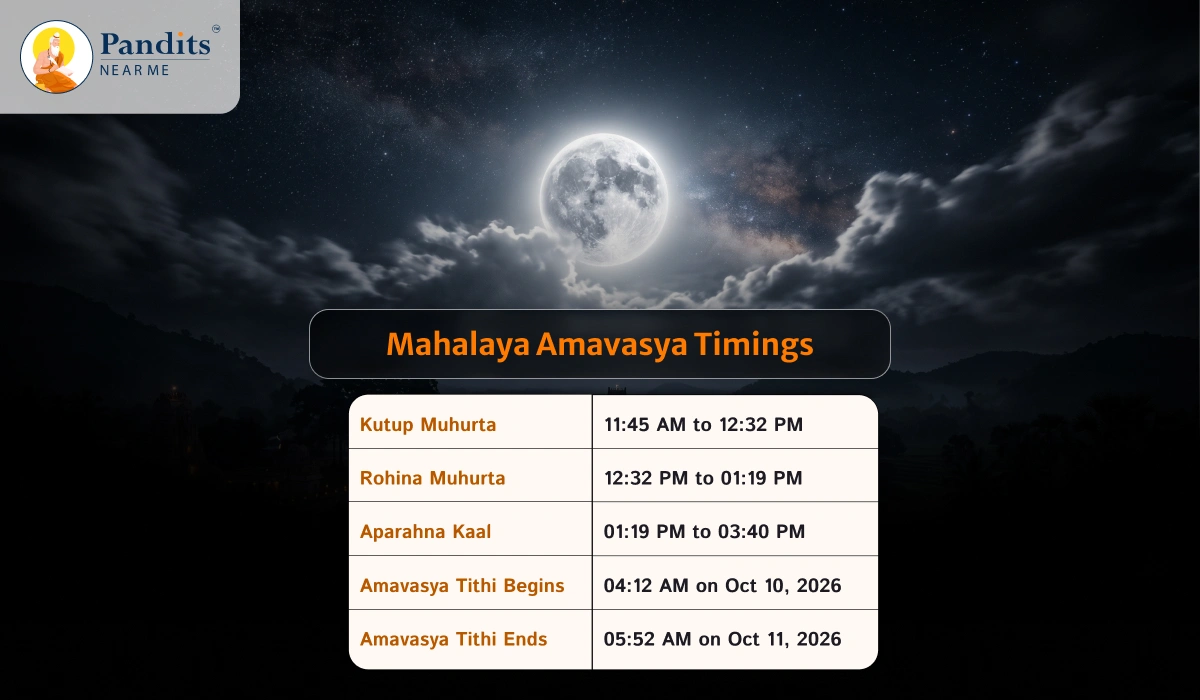
In 2026, Mahalaya Amavasya (মহালয়া অমাবস্যা) falls on Saturday, October 10, 2026. This day is important for performing Shradh for all departed souls.
Kutup Muhurat: 11:45 AM to 12:32 PM
Rohina Muhurat: 12:32 PM to 01:19 PM
Aparahna Kaal: 01:19 PM to 03:40 PM
Amavasya Tithi Begins: 04:12 AM on Oct 10, 2026
Amavasya Tithi Ends: 05:52 AM on Oct 11, 2026
Ancestral Liberation
It is the last opportunity in the year to offer Shradh to ancestors. It is believed that this day is ideal as the souls return to Pitru Loka (their abode) after spending 15 days with their descendants. Satisfying them makes sure of their blessings for the family’s well-being.
Welcoming Goddess Durga
In parts of India, and especially West Bengal, Mahalaya marks the descent of Goddess Durga to Earth. It is celebrated by listening to the Mahishasura Mardini broadcast at dawn, signaling the start of the festive season.
Also read this blog: Everything You Should Know About Pitru Paksha 2026 Rituals and Shradh
Legend of Mahalaya Amavasya
In the Mahabharata, after Karna’s death in the Kurukshetra War, his soul reached the divine realm where he met Yamraj, the god of death. Lord Yamraj informed Karna that he would face the consequences of his earthly actions.
Concerned about his ancestors who were suffering due to incomplete rituals, Karna requested Lord Yamraj to allow him to return to Earth to complete these rites.
Yamraj, moved by Karna’s devotion, granted him a brief return to Earth. During this time, Karna performed the rituals and offerings which were necessary for peace and liberation for his ancestors’ souls.
Key Rituals of Mahalaya Amavasya

Below you will find the complete, step-by-step look at the traditional rituals for Mahalaya Amavasya:
Pitru Shraadh
Pitru Shraddh is a sacred rite where food offerings, also known as Pind Daan, are made to nourish the ancestors. Traditionally, it is done near riverbanks, sacred water bodies, and even at home altars with guidance from Pandits. Pitru Shraadh involves:
Pinda (rice balls) are offered with sesame seeds
Mantras invoking ancestors
Holy water offerings
Mahalaya Amavasya Pitru Tarpanam
Pitru Tarpanam is a water offering ritual (with barley or black sesame mixed water) while chanting mantras. Tarpan nourishes ancestors in their journey and is traditionally performed at dawn or midday near a holy water body. On Mahalaya Amavasya Pitru Tarpanam is one of the most essential rites.
Charitable Actions and Daan
Charity is encouraged on Mahalaya Amavasya, especially giving in the name of ancestors. The most common offerings include:
Food distribution to Brahmins and the needy
Sesame seeds and rice
Clothes, blankets, utensils
Donations to temples, cowsheds, or charitable trusts
Such acts are done to generate Punya (merit), which is believed to be received by both the giver and ancestors.
Sarvapitri Amavasya vs Mahalaya Amavasya
Both Sarvapitri Amavasya vs Mahalaya Amavasya refers to the same spiritually significant day in the Pitru Paksha period, but the names are used differently across regions and traditions. While one emphasizes universal ancestor offerings, the other highlights the conclusion of Pitru Paksha Amavasya rituals. Understanding both helps clarify how this day is observed in different parts of India.
| Aspect | Sarvapitri Amavasya | Mahalaya Amavasya |
| Meaning | Amavasya is dedicated to all ancestors collectively (Sarva Pitru). | Final Amavasya of Mahalaya Amavasya Pitru Paksha. |
| Purpose | Performed for ancestors whose Shradh date is unknown or missed. | Marks completion of Pitru Paksha rituals and remembrance of ancestors. |
| Rituals | Shraadh, Tarpanam, food offerings, and donations. | Mahalaya Amavasya Pitru Tarpanam, Shraadh, and prayers. |
| Regional Usage | Common in North India. | Commonly used in Eastern and Southern India. |
| Importance | Offers prayers to all departed souls together. | Considered the most significant concluding day of Pitru Paksha. |
Book Experienced Pandits for Mahalaya Amavasya with Pandits Near Me
Planning the rituals of Mahalaya Amavasya 2026 date and significance in advance makes sure that all ancestral ceremonies are performed at the correct Amavasya timings with proper vidhi. Since this day holds high spiritual importance in Pitru Paksha, many families prefer guidance from experienced pandits for accurate Pitru Tarpanam and Shraadh rituals.
You can book experienced and verified Pandits for Mahalaya Amavasya with Pandits Near Me to make sure that all rituals are conducted correctly. Verified pandits help maintain traditional procedures and make the process smooth for families observing rituals for Mahalaya Amavasya.