








Marriage, or Vivah, is regarded as one of the most revered and obligatory rites in Hinduism. It's not merely a social union but a sacred union wherein two souls unite to live Dharma (righteous duty), Artha (prosperity), and Kama (love) while journeying together towards Moksha (liberation). The ancient Hindu scriptures, such as the Manusmriti and Dharmashastra, refer to the 8 forms of Hindu marriage, each with its own traditions, spiritual significance, and moral expectation.
In this blog, we’ll explore the different types of marriage in India, 8 forms of marriage, their significance, and how they reflect the values of ancient Indian society.
Understanding the Idea of Marriage in Hinduism
With all this talk about the various types of marriage in India, let's first get a grasp on the idea of marriage as understood in Hinduism. In Vedic culture, marriage is not all about friendship, it's a holy union that unites two families, two souls, and even two generations. It is regarded as a religious obligation (Dharma) that secures family and society's continuity.
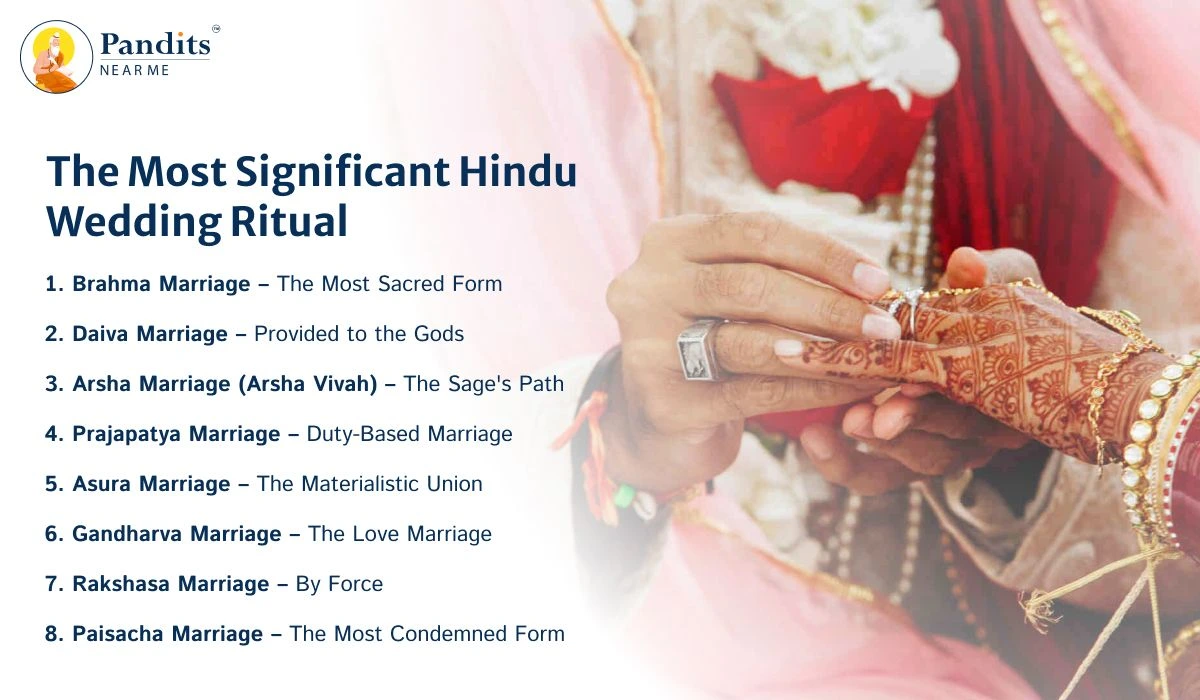
The Hindu scriptures specify 8 types of marriage (Ashta Vivah), which have two categories:
Approved or Righteous Marriages (Prashasta Vivah) – regarded as virtuous and dharmic.
Disapproved or Non-Righteous Marriages (Aprashasta Vivah) – regarded as unethical or socially unacceptable, though still valid.
Let us discuss in detail the 8 forms of Hindu marriage.
1. Brahma Marriage – The Most Sacred Form
The Brahma Marriage is also considered the superior and most chaste of all marriages in Hindu society. In this type, the father presents his daughter in marriage to a man who is knowledgeable about the Vedas and of good character. There is no dowry or worldly advantage; the marriage is purely on virtue and learning.
Significance:
The ideal form of marriage among Brahmins and scholars.
Represents purity, righteousness, and spirituality of marriage.
The primary objective is the marriage of two virtuous people who help each other obey Dharma.
Contemporary Significance:
Nowadays, Brahma Marriage exists in educated and pious families where moral values, education, and character are given more importance than wealth or position.
2. Daiva Marriage – Provided to the Gods
The Daiva Marriage is the second-best among the 8 marriages. In this case, the daughter is wedded to a priest who is undertaking a sacred ritual or Yajna. It was considered by parents as an opportunity to acquire spiritual merit by donating their daughter to a man who was in divine service.
Importance:
Symbolizes devotion and religiosity.
Regarded as an act of donation (daan) to God.
The father serves his duty by marrying his daughter to a good man who is committed to God.
Relevance in Modern Times:
Though this form of marriage is uncommon today, it reflects the value of spiritual compatibility in a marriage.
3. Arsha Marriage (Arsha Vivah) – The Sage's Path
Arsha Marriage (or Arsha Vivah) is a humble and austere practice of marriage that goes with the sages and hermits. In Arsha Marriage, the bride's father is gifted something symbolic; a cow and a bull are given by the groom as a gesture of appreciation, not as a dowry.
Significance:
Symbolizes simplicity, renunciation of materialism, and appreciation.
Predisposes marriage on the basis of respect instead of riches.
The religious intention behind the marriage is more important than social or financial considerations.
Relevance to Modern Times:
The principles underlying Arsha Marriage are appealing to contemporary minimalist and value-driven marriages wherein emotional and religious compatibility are more important than worldly possessions.
4. Prajapatya Marriage – Duty-Based Marriage
The Prajapatya Marriage encourages respect for one another and joint responsibility. The father gives away his daughter to the groom with a holy message: "May both of you together discharge your religious duties." Contrary to Brahma Marriage, this one does not need the groom to be a scholar or priest but rather a dutiful and responsible person.
Significance:
Encourages equality and partnership between husband and wife.
Charges the couple with responsibilities (Dharma) to be shared between them.
Symbolizes moral and social bonding as opposed to religious or economic standing.
Relevance Today:
This form of marriage captures the current vision of partnership on the basis of mutual respect, equality, and common objectives rendering it forever relevant.
Also read this article : What Happens at a Hindu Wedding? A Complete Guide
5. Asura Marriage – The Materialistic Union
The Asura Marriage is one of the disapproved types of marriage in Hinduism. In this form, the groom offers gifts or wealth to the bride's family in return for marrying her. It is essentially a transactional marriage, which goes against the spiritual nature of union.
Significance:
Considered materialistic and morally inferior.
Prioritizes wealth more than virtue or character.
Condemned in scriptures since it commodifies marriage.
Modern Relevance:
Though marrying for money or paying dowry still prevails in a few sectors of society, Hindu philosophy frowns upon it. The Asura Marriage is a reminder to place love and respect above money.
6. Gandharva Marriage – The Love Marriage
Of the 8 types of marriage, the Gandharva Marriage is one of the closest to contemporary society. It is a love marriage with mutual attraction and love, without family involvement or rituals. In the ancient times, it was acceptable when both parties agreed to the union due to love or lust.
Importance:
Symbolizes emotional bonding and individual choice.
On the basis of mutual agreement, love, and knowledge.
Represents liberty and respect for an individual's choice within relationships.
Relevance Today:
Love marriages today are contemporary forms of Gandharva Marriage. It is in sync with values of autonomy, emotional compatibility, and personal happiness.
7. Rakshasa Marriage – By Force
The Rakshasa Marriage is a forceful and disapproved kind of marriage, in which the groom takes away the bride by force against her will, usually in the midst of war or conflict. This kind of marriage was occasionally prevalent among warriors or Kshatriyas in the past.
Meaning:
Symbolizes aggression, dominance, and absence of consent.
Disapproved in scriptures because it violates the philosophy of Ahimsa (non-violence) and respect.
Represents abuse of authority and lack of concern for justice.
Relevance to Modern World:
In the contemporary world, any marriage without consent is illegal and immoral. The Rakshasa Marriage emphasizes the significance of consent and respect in marriage.
8. Paisacha Marriage – The Most Condemned Form
The Paisacha Marriage is the worst and most sinful of the 8 forms of marriage. It is a marriage when a man has sex with or rapes a woman when she is asleep, drunk, or is mentally deranged. This is considered a serious sin and is wholly condemned in all Hindu texts.
Significance:
Symbolizes exploitation and immorality.
Condemned for breaking human and divine law.
Regarded as an act of Adharma (unrighteousness).
Modern Relevance:
This act is criminal in today's law and entirely against the moral and ethical principles of marriage. The Paisacha Marriage is a lesson against exploitation and disrespect towards women in any form.
The Spiritual and Social Message Behind the 8 Types of Marriage
The 8 forms of marriage illustrate how well ancient Indian society knew about human relationships. Each type of marriage shows some other aspect of human nature ranging from spirituality and responsibility to love and greed. The system was created to educate that although some forms maintain Dharma, others depict moral downfall.
The initial four marriages (Brahma, Daiva, Arsha, and Prajapatya) are noble and dharmic and denote purity, duty, and righteousness. The last four (Asura, Gandharva, Rakshasa, and Paisacha) are adharmic (unrighteous) and impart to humanity what ought not to be practiced in the quest for marital bliss.
Marriage as a Divine Obligation, and Not Merely an Agreement
Marriages in India have changed legally in contemporary India but continue to have a divine essence. Hindu marriage traditions such as Saptapadi (seven steps) and Mangal Phera continue to focus on the eternal union of husband and wife.
The different types of marriage in India, particularly in Hinduism, remind us that marriage is not all about social acceptance, it's a religious pact based on trust, respect, and spiritual development.
Conclusion
The 8 different types of marriage in India as described in ancient Hindu scriptures provide timeless insights for today's relationships. Although society has evolved, the core principles of Brahma Marriage, Arsha Vivah, and other dharmic marriages continue to guide us towards balance, respect, and purpose in our marriages.
Learning about the 8 forms of marriage is only the first step towards respecting this timeless tradition. To have your wedding ceremonies conducted with utmost Vedic accuracy, let veteran pandits lead the way.
At Pandits Near Me, we link you with trained and aware Hindu pandits for every wedding ceremony from Kundali Milan and Vivah Muhurat determination to full Vedic Vivaah Sanskar.