








Hindu marriage is more than a social union; it is a religious bond between two souls meant to uphold dharma and continue the bloodline. A Vedic wedding or Vaidik Vivah is an ancient ceremony that has existed for thousands of years, adhering to the directives found in the ancient Vedas. Every step, chant, and ritual in the Vedic wedding is sacred, symbolizing purity, devotion, and divine blessing.
In this blog, we’ll explore what exactly happens during a Vedic marriage, the significance of each Vivah Sanskar ritual, and why it continues to hold importance in modern times.
Understanding the Concept of Vedic Marriage
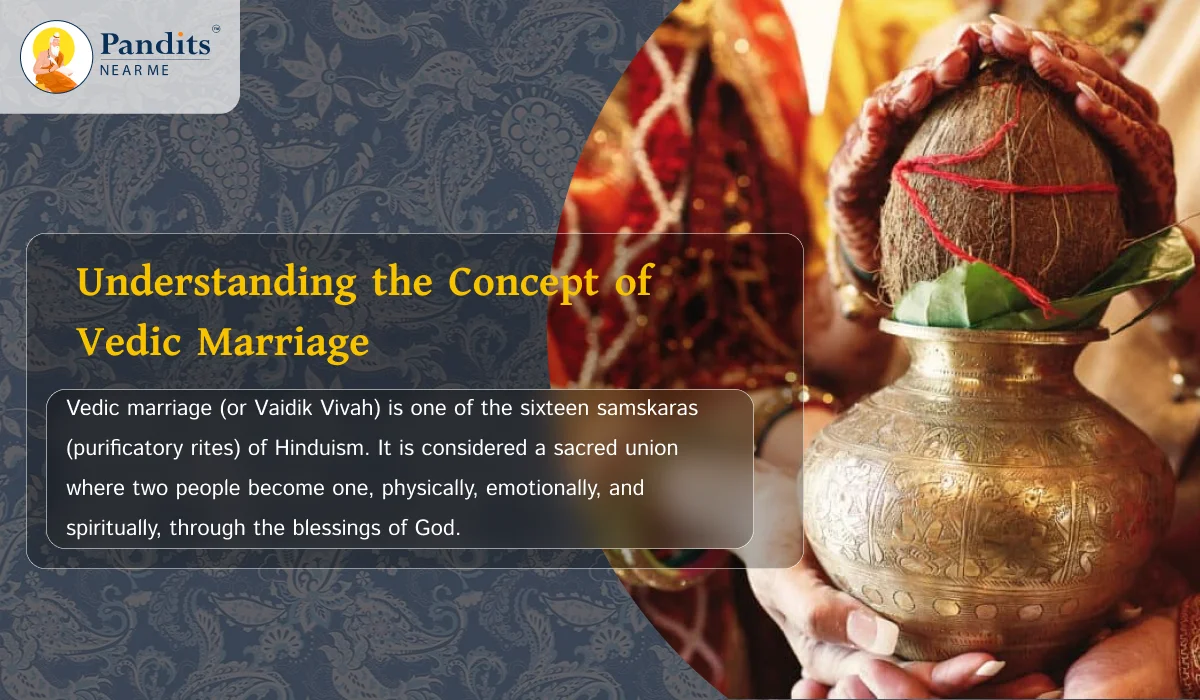
Vedic marriage (or Vaidik Vivah) is one of the sixteen samskaras (purificatory rites) of Hinduism. It is considered a sacred union where two people become one, physically, emotionally, and spiritually, through the blessings of God, the guidance of ancestors, and the wisdom of sages.
It is based on values like respect for one another, joint responsibilities, and husband-wife harmony. It is believed that a properly conducted Vaidik marriage makes it possible for both parties to grow together in the direction of dharma and spiritual growth.
In contrast to contemporary civil weddings, Vedic wedding ceremonies are highly symbolic as they cleanse the couple's energy, call upon divine presence, and align them with the cosmic order.
Importance of Vivah Sanskar
Out of all the samskaras described in the Vedas, Vivah Sanskar is perhaps the most important as it is the beginning of the grihastha ashram (householder stage of life).
Hindu philosophy has four stages of life: Brahmacharya (student life), Grihastha (householder life), Vanaprastha (retirement), and Sannyasa (renunciation). Vivah Sanskar fills the gap between spiritual discipline and worldly obligations.
Through Vaidik marriage, one enters into the stage where one is supposed to live his life diligently, taking care of the family, discharging rituals, and contributing to society. So it's not just a festival; it's obligatory sacredness (dharma).
Pre-Wedding Rituals in a Vedic Wedding Ceremony
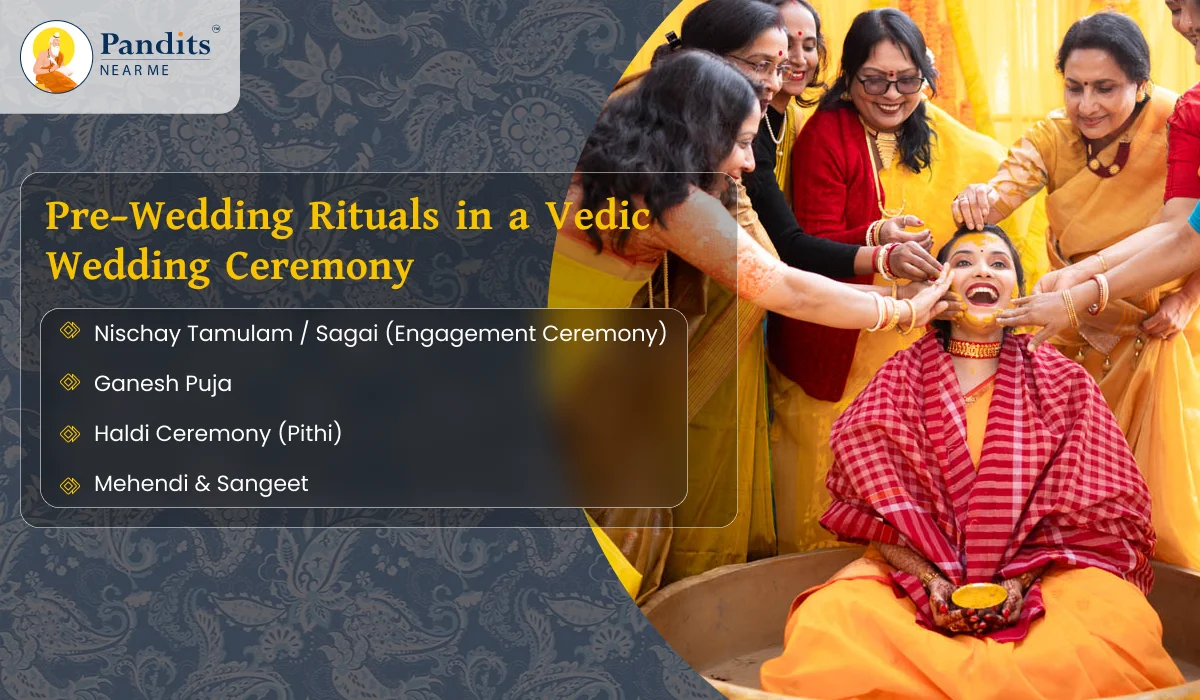
Before the wedding day, several Vedic wedding ceremonies prepare the bride and groom spiritually and mentally for marriage. These rituals purify their aura and seek blessings from the gods and ancestors.
Nischay Tamulam / Sagai (Engagement Ceremony): The wedding is officially announced by the bride's family and the groom's family. Suitable dates (muhurta) are selected on the advice of consulting a priest or astrologer.
Ganesh Puja: The wedding ceremony begins with the pooja of Lord Ganesha to remove obstacles and make the wedding a smooth process.
Haldi Ceremony (Pithi): Turmeric paste is applied on the body of the bride and groom to wash away impurities and bless them with wealth and beauty.
Mehendi & Sangeet: Though these are less Vedic and cultural, they introduce the fun and the families getting to know each other before the rituals begin.
Also read this article : Rahu Mahadasha Effects: What Happens in Rahu Dasha and Remedies
The Main Vedic Marriage Rituals
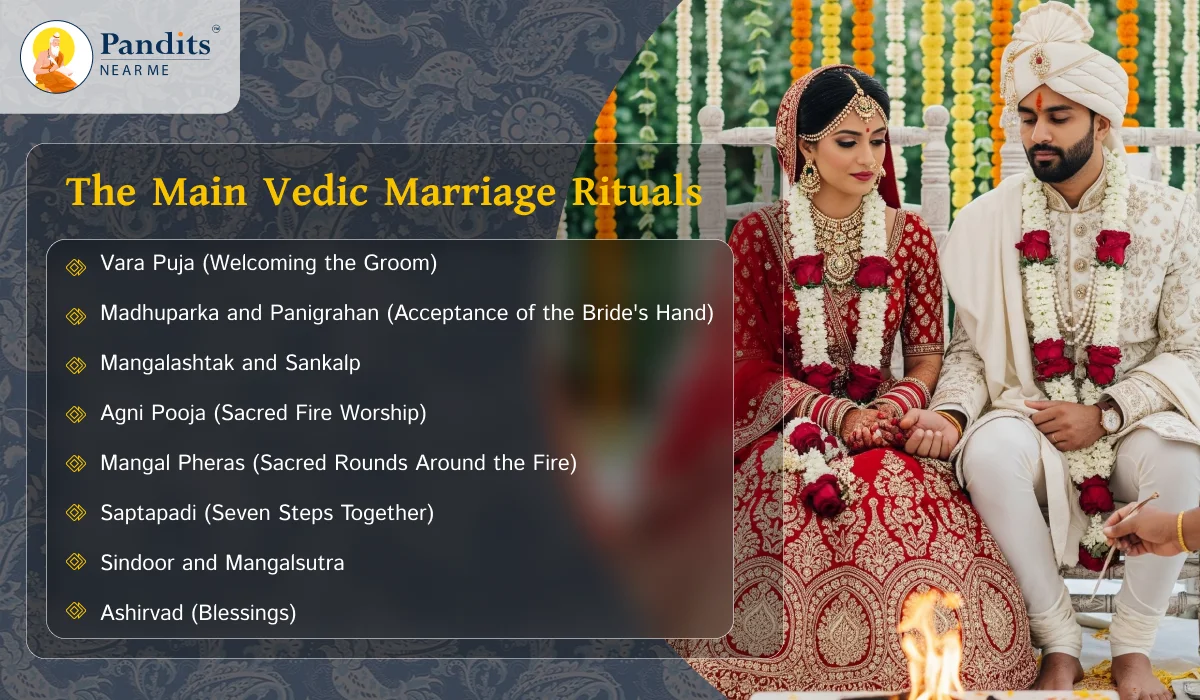
The main Vaidik wedding is performed close to the sacred fire (Agni), which is regarded as the divine witness of the marriage. Every ritual performed during the entire Vedic wedding ceremony holds deep spiritual meaning.
Below is a guide on Vedic marriage rituals:
Kanyadaan
This is the most significant Vedic wedding ritual. The bride's father gives away his daughter to the groom, entrusting her happiness and welfare to him.
It represents the reality that the bride is a gift of God, an embodiment of Goddess Lakshmi, and her acceptance by the groom signifies the union of two families and bloodlines.
Vara Puja (Welcoming the Groom)
The groom is believed to be a reincarnation of Lord Vishnu by the bride's family. They perform aarti and wash his feet as tokens of respect and purification.
Madhuparka and Panigrahan (Acceptance of the Bride's Hand)
During Madhuparka, a honey and curd mixture is presented to the groom as a sign of sweetness in married life.
Then Panigrahan is performed, in which the groom takes the hand of the bride and vows to be her companion in righteousness, wealth, and love.
Mangalashtak and Sankalp
Holy words called Mangalashtak are chanted, seeking blessings of harmony and bliss on the couple. Both take a formal pledge (Sankalp) to live together in harmony and dedication.
Agni Pooja (Sacred Fire Worship)
The priest lights the sacred fire, representing Agni Dev, the sacred witness. Ahuti (offering) is made to invoke blessings from the gods.
Mangal Pheras (Sacred Rounds Around the Fire)
This is the crux of the Vedic wedding ceremony. The bride and groom go around the fire seven times, exchanging vows each time. Every phera is a vow from food and strength to love, fidelity, and life-long companionship.
The seven pheras symbolize: Food and prosperity, Strength and courage, Wealth and health, Joy and love, Children and family, Good health and long life, and Friendship for eternity and spiritual marriage.
Saptapadi (Seven Steps Together)
The couple then proceeds to take seven symbolic steps together after the pheras. This symbolic action ends the marriage officially. Each step represents duties shared by them, like faithfulness, nourishment, vigor, prosperity, and mutual understanding.
Once the seventh step has been completed, the marriage becomes legal and divine in the Vaidik wedding process.
Sindoor and Mangalsutra
The groom applies sindoor (vermilion) on the bride's forehead and ties the mangalsutra (holy necklace) around the bride's neck. Both are indicative of her new role as a married woman and the holy commitment of the Vedic marriage.
Ashirvad (Blessings)
The bridegroom and bride also touch the feet of elders to take their blessings for a long, happy, prosperous, and successful married life.
Post-Wedding Rituals
While the formal Vedic wedding ceremony is over, some post-wedding ceremonies add emotional and cultural depth.
Griha Pravesh: Upon entering her new home, the bride is welcomed with aarti. She is then asked to gently push a vessel of rice with her right foot. It is a sign of good fortune and prosperity, entering the family.
Satyanarayan Katha: Some couples perform a Satyanarayan Puja as a gesture of thanks to the Gods for completing the Vedic wedding ceremony. It is also believed to bestow on the couple an endless bliss.
Why Vedic Marriage Is Important Even Today
Despite the age of destination weddings and short ceremonies in today's times, there's no match for the depth and beauty of Vedic wedding ceremonies.
A Vedic wedding fills the couple with awareness, thankfulness, and spiritual bonding. It gives them a good beginning to life as two, with a solid cultural and spiritual foundation. In a majestic temple or humble abode, a Vaidik Vivah reminds one that love is not just emotion; it is duty, devotion, and shared spirituality.
Conclusion
If you’re planning a Vaidik marriage, remember that it is more than just a series of rituals; it is a celebration of unity, devotion, and lifelong companionship as guided by the Vedas. By embracing the Vivah Sanskar, couples honor time-honored Hindu wedding traditions while inviting peace, purity, and purpose into their married life.
Begin your Vedic marriage (Vaidik Vivah) with the blessings of God. Book professional Vedic pandits from Pandits Near Me to perform all Vivah Sanskar with devotion and affection.