









With winter drawing to a close, India is ready to celebrate one of its most joyous festivals: Makar Sankranti. But do you know the real significance of Makar Sankranti and why it's celebrated with such vigor across different regions? Rooted deeply in Vedic traditions, Makar Sankranti marks the Sun's entry into Capricorn (Makara Rashi), which signals the end of darkness and the beginning of longer and warmer days.
History dates back thousands of years in the celebration of Makar Sankranti, a time to pay respect to the Sun God- Surya Dev-and the first harvest of the season. Beyond the rituals and kite flying, the essence of Makar Sankranti is essentially thanksgiving-positivism-renewal.
In this blog, we will explore Makar Sankranti, the importance of Makar Sankranti, its traditions, and why it still occupies a timeless place in Indian culture today.
Makar Sankranti 2026: Date & Time

In 2026, Makar Sankranti will fall on Wednesday, January 14.
The exact auspicious Makar Sankranthi time (Sankranti muhurta) is 03:13 PM, and the Punya Kala available to perform all rituals is from 03:13 PM to 06:02 PM, approximately 2 hours 49 minutes.
Since Sankranthi is decided according to the solar calendar and not the lunar calendar, Makar Sankranti is one of those very few Hindu festivals that falls on nearly the same day every year - normally January 14.
What is Sankranti? Meaning & Historical Background
To understand what is Sankranti, first learn that "Sankranti" means a change, i.e., the Sun's movement from one zodiacal sign to another. Makar Sankranti is the entry of the Sun into Makara.
The Makar Sankranti history goes back to the Vedic era and observations about the sun. It is a harvest festival that marks the beginning of the harvest season in the country and the end of winter.
In ancient Vedic societies, the day was considered sacred because the Sun starts his path towards the north, which is conceptualized as a movement towards greater light, heat, and life.
Hence, if we ask what the Sankranti festival is, it is this solar change phenomenon; and about Makar Sankranti, all the ritualistic, cultural, and symbolic aspects concerning it are included.
Significance of Makar Sankranti
Spiritual and Religious Significance
Makar Sankranthi is important because of the symbolism it carries:
• It is believed that Uttarayan ushers in positivity, spiritual growth, and new energy as the Sun starts to move northward.
• It is especially a sacred day for donation, penance, and other spiritual practices like meditation and offering alms to the poor.
They take holy dips in holy rivers like the Ganga, Yamuna, Godavari, etc., believing that such dips wash away sins and impart blessings.
Agricultural & Seasonal Significance
As a harvest festival, Makar Sankranti holds immense significance in an agricultural community:
• It marks the beginning of the end of winter and a new hope for warmer days and better yields of crops.
•The farmers thank Surya, meaning the Sun, for favorable crop growth and hence their very existence.
• Various regional harvest traditions and food items are shared in the festival, like fresh grains, fresh fruits.
Cultural and Social Importance
• It is one of those rare Hindu festivals that are fixed-date; thus, people look forward to it every year.
• Kite-flying, fairs, and social gatherings in most Indian states are used to promote friendly relationships.
The festival also develops amiable relationships, sharing of sweets, and amity.
Also read this article : 27 Nakshatras in Hindu Astrology: Names, Meanings, and Characteristics
Rituals & Customs: What to Do on Sankranti Festival
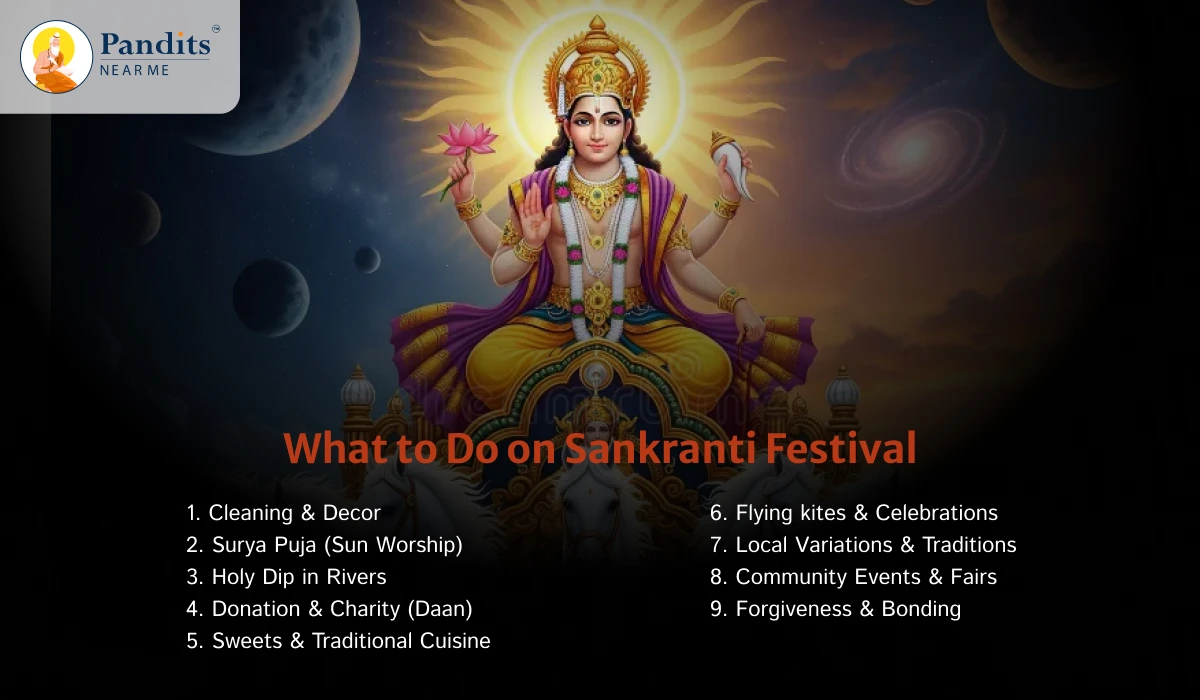
If you are wondering what to do on Sankranti, here is an overview of general practices and the regional variations followed for celebrating Makar Sankranti:
1. Cleaning & Decor
Houses and temples are thoroughly cleaned. Rangoli, mango leaves, and floral decorations are usual.
2. Surya Puja (Sun Worship)
• Early morning, pilgrims face east and offer water, milk, sesame (til), jaggery (gud/gur), and flower petals.
• Repetition of mantras or Gayatri Mantra and offerings for health, prosperity, and happiness.
3. Holy Dip in Rivers
Dipping in sacred rivers or lakes is a highlighted ritual. Many gather on the banks of rivers for this purpose.
4. Donation & Charity (Daan)
Food, clothes, grains, or sesame sweets distributed among the needy are held very sacred.
Charity and donation in the time of Punya Kala are said to yield greater spiritual merit.
5. Sweets & Traditional Cuisine
Til (sesame) and jaggery sweets, for example, tilgul, til laddoo, til patti are symbolic staples.
• In other states: pongal in Tamil Nadu, khichdi or pongal varieties in others, undhiyu in Gujarat, and puran poli in Maharashtra.
6. Flying kites & Celebrations
Some of the most outward-looking traditions include kite flying, especially in Gujarat and Rajasthan. The sky is filled with multicolored kites, and the day is turned into a competitive fun-fest.
7. Local Variations & Traditions
• In Tamil Nadu, it is celebrated for four days as Pongal.
•Lohri (last night) holds significance in Punjab / North India; dancing, singing folk songs, and burning bonfires are characteristic features of the celebration.
• In West Bengal/Assam, the festival is celebrated as Poush Sankranti/ Magh Bihu.
8. Community Events & Fairs
Community fairs (melas) and congregations are the usual aftermath of sankranti festivities: handmade crafts stalls, folk performances, food, and sweets.
9. Forgiveness & Bonding
In many places, people forgive and forget past misunderstandings, share sweets, and reunite. The phrase "Tilgul ghya, god god bola," which means "take tilgul and speak sweet," is usually said
Makar Sankranti 2026: Timing & Auspicious Window
As mentioned earlier, the sankranti makar moment in 2026 is 03:13 PM, and Punya Kala goes until 06:02 PM.
It is this divine window that the main rituals, such as Sun worship, charity, and sacred baths, can be performed. Most people believe that deeds done during Punya Kala are more spiritually productive.
In fact, Sankranthi may last only for a few minutes, but the longer duration is used because of convenience.
How to Celebrate Makar Sankranti 2026
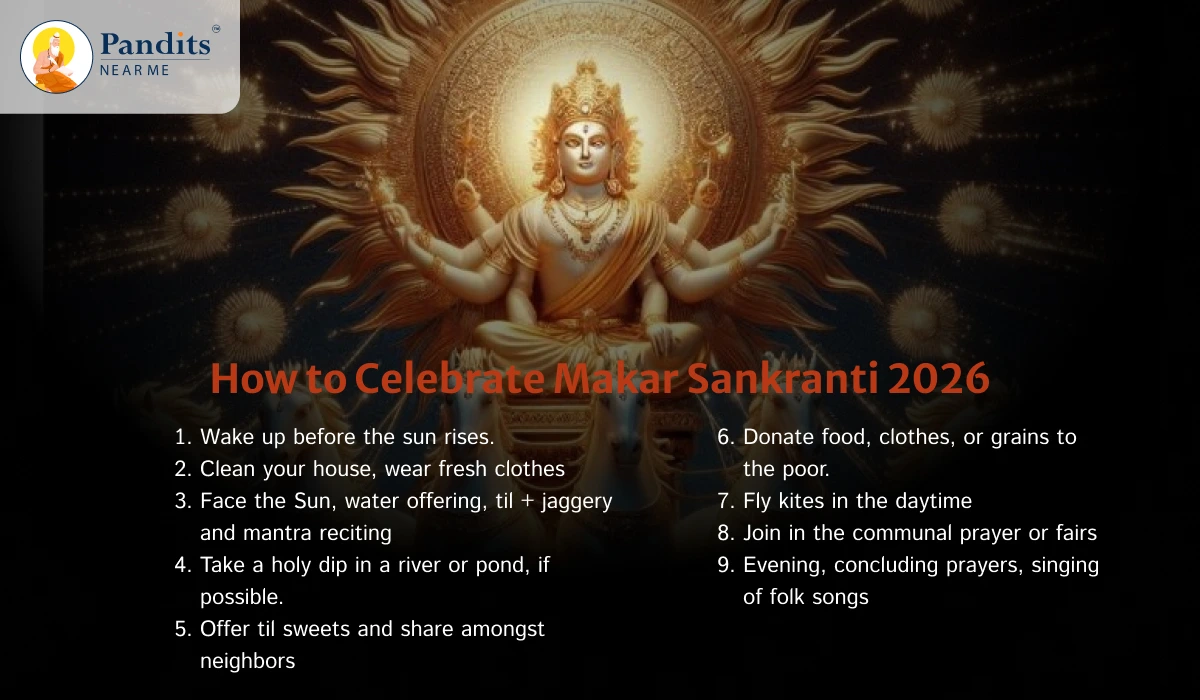
Here is a daily plan/ritual list that you can use on how to celebrate Makar Sankranti on 14th January, 2026:
1. Wake up before the sun rises.
2. Clean your house, wear fresh clothes
3. Face the Sun, water offering, til + jaggery and mantra reciting
4. Take a holy dip in a river or pond, if possible.
5. Offer til sweets and share amongst neighbors
6. Donate food, clothes, or grains to the poor.
7. Fly kites in the daytime
8. Join in the communal prayer or fairs
9. Evening, concluding prayers, singing of folk songs, or social gatherings
These steps contain most of the traditional Makar Sankranti rituals and keep you completely engaged.
Makar Sankranti Example & Local Flavors
To bring the festival of Makar Sankranti alive, here is an example of the same in Gujarat:
In the same state, on Uttarayan, as it is known locally, families wake up early, "sun salute," then run to the roofs to indulge in flying kites. During noon, people relish undhiyu, til chikki, til ladoo, garlic chutney, and tea. From dawn to dusk, friendly kite fights go on, and music plays at every corner, with communities coming together. This colourful example catches the spirit of what to do on Sankranti festival in said state.
Similarly, during Pongal in Tamil Nadu, people cook Pongal rice using solar ovens of earth in sunlight, decorate cattle, sing folk songs, and celebrate for four days.
Practical Benefits
In addition to religious and cultural importance, the Makar Sankranthi celebration has practical benefits:
• Boosts outdoor activity, such as flying kites in cooler January weather
• Strengthens bonds among members of the society through eating together and socializing
•Gives life to traditional cuisine and maintains the cultural heritage.
It cultivates an attitude of thankfulness and generosity.
• It reminds us of nature's cycle and man's dependence on the Sun.
Tips to Celebrate Sustainably
•Take sweets in advance so that you can give and share promptly.
•Wear bright or traditional clothes to reflect the joy of the festival.
•Fly kites with eco-friendly strings to be environmentally friendly
•Join in with community celebrations to share fun and culture
•Plan to go to the river banks for sacred dips
• Keep a gratitude diary or social post on this day of gratitude.
Conclusion
Makar Sankranti 2026 is more than a festival; it is a celebration of the Sun, harvest, people, and spiritual rejuvenation. It is a bridge between cosmological events and human thankfulness, allowing us to thank nature and connect with people in our vicinity.
If you are curious to know what is Sankranti, or how to celebrate Makar Sankranti, Makar Sankranti history, or even the importance of Makar Sankranti, the spirit is always universal: warmth, light, renewal, and happiness.
May your Makar Sankranti be blessed, filled with sweet til delicacies, clear skies, and the warmth of tradition.